Choosing an Odoo integrator: 5 questions to ask.
There are generally five main criteria that can help you effectively evaluate Odoo integrators. However, a reliable assessment depends first and foremost on what you have prepared before the call.

The essentials.
There are generally five criteria that can help you effectively evaluate Odoo integrators: the respective roles of the vendor and the integrator; their track record with projects similar to yours; the quality of the demonstration tailored to your specific challenges; the project’s budget range; and the methodology and résumés of the assigned consultants. But the final choice also depends on less tangible factors, how well you connect with the team, the instinctive trust your point person inspires, and a certain chemistry that can’t be explained on a spreadsheet.
A reliable budget range depends on information that only you have: scope of priorities, tools already in place, number of target users, and decision timeline.
Two red flags come up time and time again: a generic demonstration and a quote without written assumptions.
Once the number of users exceeds a few dozen and involves multiple business units, the selection process becomes more formalized: rating scale, standard coverage rate, full cost, and the service provider’s long-term viability.
Two integrators can present the same Odoo solution and deliver two very different projects. What sets them apart comes down to three sets of questions: the ones you ask them, the ones you ask yourself before contacting them, and the ones that come up during a formal consultation. Here are the three lists, along with the reassuring answers and the associated red flags.
What questions should you ask an Odoo integrator during the first meeting?
Five questions are enough, and none of them require technical expertise. The point isn't to get the right answer, it's to identify the ones that remain vague.
1. Introduction to the Publisher and the Integrator, who does what between Odoo and the service provider.
The reassuring answer: The service provider clearly distinguishes between the publisher's responsibilities (product, versions, licenses, publisher support) and its own (scope definition, configuration, development, training, maintenance).
The warning signal: The presentation mixes the two, or presents Odoo as its own solution.
2. Client references that are similar to your project, same job, same size, same workflows.
The reassuring answer: two or three projects listed, including the scope, actual duration, and a contact person who can be reached.
The warning signal: a list of logos with no scope or point of contact.
3. Presentation of screens illustrating your business requirements.
The reassuring answer: a demonstration that covers your use cases, including the specific scenarios you described.
The warning signal: a standard demonstration that is the same for all prospective customers.
4. Initial budget estimate for the entire project.
The reassuring answer: a clearly defined range, including a breakdown of the components (Odoo licenses, scope definition, configuration, development, data migration, training, and maintenance) and the written assumptions underlying it.
The warning signal: a one-time price with no assumptions, or a refusal to provide a rough estimate until after several billed workshops. Also be wary of prices that are abnormally low compared to the competition: this may indicate a misinterpretation of the scope of work, a deliberate underestimation, or a risk of cost overruns and unanticipated amendments not covered by the initial budget.
Conversely, a higher price shouldn't put you off right away. What does it actually offer? The service provider may have included steps or elements that others have omitted, either intentionally or out of oversight. A careful reading of the proposal can shed light on the unclear aspects of your project and help you think through your options. As a wise person once said, “We can’t afford to buy cheap.”
5. Methodology and consultants’ résumés.
The reassuring answer: the name of the assigned business analyst, their experience in your industry, and the opportunity to meet with them before signing the contract. Resumes and the specific team composition may be provided after the final presentations, this is normal, but they must be finalized and approved by you before hiring.
The warning signal: a generic methodology without specific implementation details, a team assigned only after the contract is signed, or the key consultant’s unavailability for discussion prior to signing the contract.
Two useful points about the ecosystem.
First, Odoo also offers its own implementation services for projects that do not involve major custom development. For this type of project, it makes sense to compare the two options: Odoo directly versus a partner. For projects with a significant custom development component or those requiring local expertise, Odoo generally directs clients to its partners, narrowing the scope for comparison. Second, Odoo classifies its official partners into three tiers, Ready, Silver, and Gold, based on three criteria: the number of new Enterprise users sold over a 12-month period, the number of employees certified on the latest versions, and the customer retention rate.
10 Questions to ask yourself before contacting an integrator.
An integrator can't provide a quote for something you haven't yet prioritized. This is the part of the job that no one will do for you, and it accounts for most of the discrepancies between the estimated budget and the final budget.
1. The three problems you want to solve or automate first.
What this means in practice: it defines the scope of the first phase and avoids listing everything Odoo can do
2. The budget your company can commit to, and that’s the deciding factor.
What this means in practice: it allows the integrator to propose a realistic scope rather than an unachievable project
The question to be decided internally is simple: what budget have you allocated in your business plan, and who makes the final decision? If no amount has already been approved, a benchmark helps frame the discussion. For the structured Odoo projects we lead, the initial investment is most often between 1% and 2% of annual revenue.
This guideline is primarily intended to help you gauge the scale of your project before scheduling meetings. If your project falls below this range, starting with the basics remains a sound option: an Odoo Essential Pack covers the key modules within a deliberately limited scope, with implementation in four weeks, and then expands module by module once usage is established.
3. The tools used today, on an app-by-app basis.
What this means in practice: distinguish between what will be replaced, that is, the subscriptions you’ll stop paying for—and what you’ll keep using despite Odoo (payroll, HRIS, EDM, business tools). Each tool you keep requires an interface to be built, connected, and maintained—an additional cost center.
4. Prioritizing the desired modules.
What this means in practice: a project covering sales, purchasing, and accounting cannot be compared to a project that also covers production, inventory, and the e-commerce site
5. The number of employees and the number of target Odoo users.
What this means in practice: It determines the license cost, regardless of the services provided
6. The solutions you are evaluating simultaneously.
What this means in practice: it helps put the comparison into context and avoids three months of back-and-forth discussions that ultimately result in a choice of business software
7. The structure and quality of your current data.
What this means in practice: it determines the scope of the recovery effort, a clean product file and a history scattered across ten binders require different amounts of work
8. Your ability to adapt to change.
What this means in practice: agreeing to revise a process to comply with the standard reduces the need for custom development, and thus lowers the budget and shortens the implementation timeline
9. The demonstrations you want to see, described in terms of use cases.
What this means in practice: “I sell on my website, I prepare the order, I ship it, and I invoice the customer” is better than “Show me the sales module.”
10. The Decision-Making and Launch Schedule.
A decision made in September for a January launch does not require the same teams as a preliminary assessment.
One exercise is enough to cover half of this list: draw a diagram on a page showing the applications you use and the workflows between them. Many companies discover at this point that they didn’t have a consolidated view of their information system.
General-purpose tool or industry-specific software: how do you decide?
This question comes before choosing an integrator, and it deserves an honest answer. A general-purpose ERP like Odoo covers a broad scope with a single data repository: fewer interfaces, a single contract, and consistent data from lead generation to payment collection. On the other hand, for a function that’s very specific to your industry, dedicated software may sometimes be more refined from the start, but be aware that both options require custom development.
So the real question isn’t “Odoo or no Odoo,” but “Are you ready for custom development? And where will you have it done—in-house or outsourced?” In either case, there’s a specific cost to factor into your budget.
The tipping point is measurable: if the specific function accounts for the bulk of your business’s value and no off-the-shelf solution comes close to meeting your needs, specialized software, possibly integrated with an ERP system for the management side—remains the right choice. If your needs span five or six areas, none of which are truly out of the ordinary, a broad-coverage solution is the better option. An integrator who refuses to address this scenario is essentially telling you that they’re selling a product, not a project.
How should you structure your selection process based on the size of your organization?
The level of formality must be commensurate with what is at stake. There are three distinct cases.
Small organization | Standard scope, a few users.
All it takes is a qualification call and a quote. Consult with two service providers, compare the consultant’s rate range and availability, and start with a deliberately limited scope.
We’ve created a dedicated solution, the Odoo Essential Pack: a simplified implementation focused on standard features, specially designed for smaller projects that need to be up and running quickly.
Medium-sized organization | Multiple business lines, ranging from about 10 to several dozen users.
Include a demonstration based on your use cases, followed by a detailed cost breakdown by batch. Consult two or three system integrators on the same set of requirements; otherwise, the quotes will not be comparable.
Large organization | Multiple companies or locations, numerous users, diverse business lines.
The selection process becomes a formal consultation, and the rating grid is included in the file. The 11 criteria we most often find in these consultations are:
Compliance with the consultation schedule, the expected format of responses, and the schedule for the defense presentations; a service provider who fails to adhere to the required format will also fail to manage the project effectively.
Coverage rate functional requirement as standard, expressed as a percentage and explained line by line.
Ergonomics and simplicity usability, as evaluated by end users rather than by management alone.
Total purchase cost over several years, recorded in a standard template: licenses, services, development, interfaces, hosting, maintenance, and version upgrades.
Quality of customer references: functional proximity, comparable size, reviews obtained directly.
Ease of administration: What your teams will be able to configure without having to contact the service provider.
Speed of implementation and the ability to deliver in batches rather than in a single rollout.
Ability to handle multiple roles within a single system (maintenance, leasing, construction site or project management, production).
Long-term viability of the publisher and the integrator, ability to deliver results over the long term, quality of communication during the consultation.
Availability, location, and support languages, especially for a multinational group.
Product roadmap, including the integration of artificial intelligence features and the version upgrade policy.
This checklist is still useful for a smaller organization: four or five of these criteria, rated honestly, are better than a decision based on a good first impression.
What Dynapps observes during qualification calls.
Companies that come in with a three-line scope of work receive a budget range right from the first discussion. Those who ask for “everything Odoo can do” receive a figure that surprises them, not because the project is expensive, but because it hasn’t been defined.
We also sometimes conclude, after an evaluation, that a project isn’t ready: the budget hasn’t been approved, there are no internal sponsors, or the need is actually met by existing business software. Saying so at that point is less costly for both parties than finding out six months later. That’s also why we prefer a brief, straightforward initial conversation to a glossy demonstration.
Frequent questions we receive from companies
Should we go through Odoo or an integrator? Odoo offers its own services and refers large-scale projects or those with highly specialized components to its partners. Compare the two based on the same criteria: consultant availability, knowledge of your industry, and long-term commitment.
Is a Gold partner a better choice? This tier reflects the number of licenses sold, the number of certified consultants, and the retention rate. It is an indicator of strength, not proof of suitability. References comparable to yours remain the most predictive criterion.
Can we get a quote right away when we first call? A rough estimate, yes, if you provide the scope of priority, the number of target users, and the tools to be replaced. An accurate quote requires a detailed assessment, at least a demonstration, and a scoping exercise.
Scoping is a paid service that allows us to precisely refine your budget following the assessment phase. It’s an investment, but it drastically reduces the risk of inaccurate estimates and budget overruns down the line. Some complex projects also benefit from a paid Proof of Concept (POC), which validates technical and methodological choices before the main contract is signed. These two steps come at a cost, but they provide clarity and limit surprises.
How many system integrators should I consult? Two for a standard scope, three for a cross-functional project. Beyond that, the time required for analysis outweighs the benefits of comparing options, unless competitive bidding is required.
How long does it take to choose an integrator? Allow a few weeks for a standard scope, and two to three months for a formal review process that includes oral defenses and a grading rubric.
Discuss your project
Have you prepared the answers for the second section and want to get a rough idea of the scope? Talk to an Odoo consultant at Dynapps: one call, your priorities, a rough estimate, and an honest opinion on feasibility, even if the answer is “not right now.”
More posts like this

3-minute read
Interview with Leïla Chojnacki, Deputy CEO and CFO of the Obiz Group
3 minute read
Odoo 19.4: What's new? Key features and essential takeaways
Odoo 19.4 (July 2026) is a quarterly update: connection to AI agents via MCP, voice interaction, editable margins, two-tier duplicate detection, stock aging report, and continuous production.
3 minute read
AI in Odoo: What are the requirements for enabling it?
The question "Do we have the right to use Odoo's AI?" often has a simpler answer than expected.

4 minute read
Electronic invoicing 2026: Odoo and Dynapps France are ready
Electronic invoicing 2026 is just around the corner: discover how Odoo and Dynapps France are helping you prepare today for this essential transition.

3 minute read
La méthode Dynapps pour un projet Odoo réussi
Choosing an ERP is about more than selecting software. The success of an Odoo implementation also depends on understanding your business challenges, structuring your processes, supporting your teams, and ensuring the solution evolves alongside your business over time.

4 minure read
Certified by Dynapps: Bringing Odoo Expertise to Local SMEs in France
Dynapps France is launching the “Certified by Dynapps” label, a program that provides small and medium-sized businesses with local Odoo expertise and offers independent consultants a structured framework for growing their Odoo-related businesses.
4 minute read
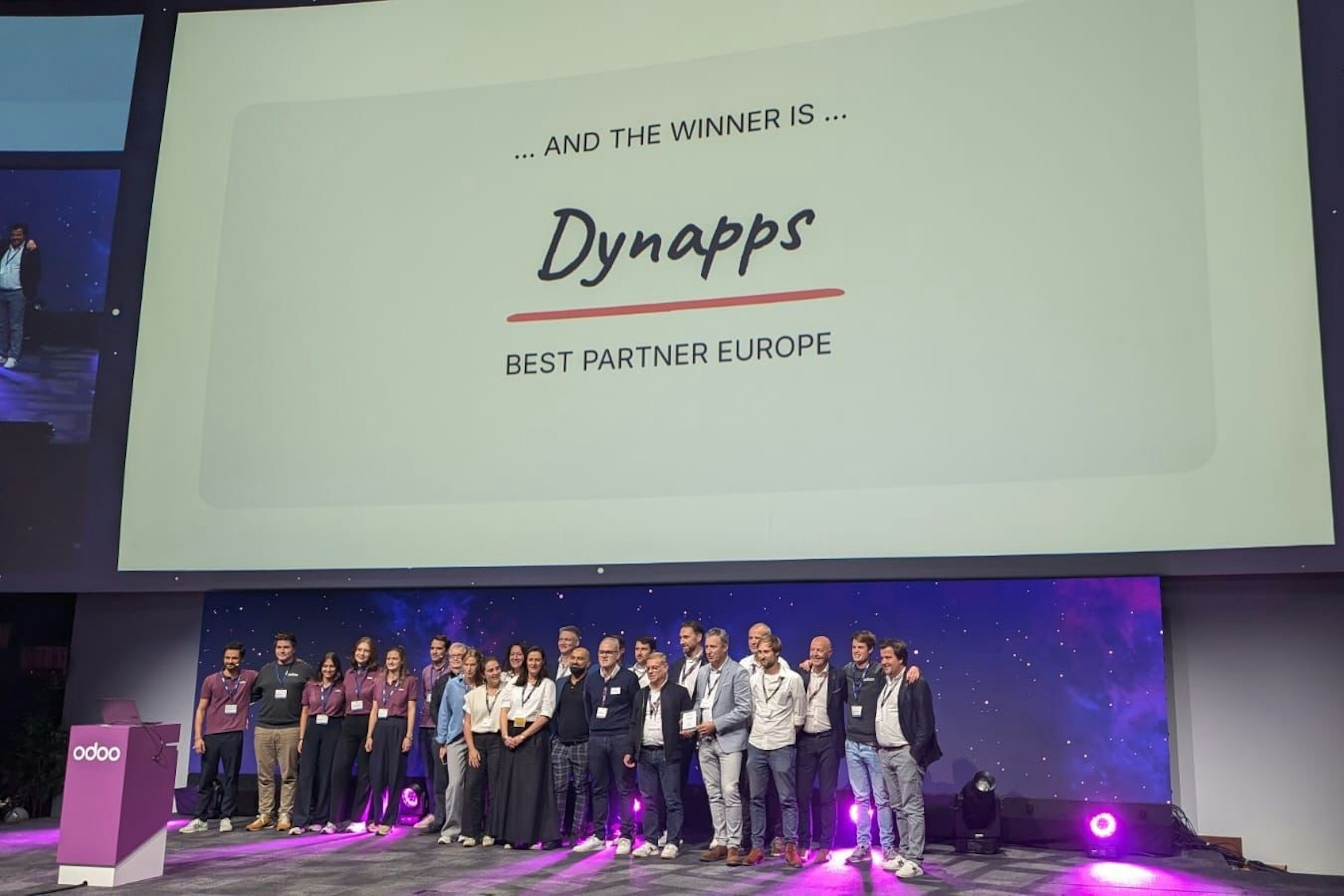
Dynapps named Best Odoo Partner in Europe
At the Odoo Experience Days in Brussels, Dynapps won the title of Best Odoo Implementation Partner in Europe, with former CEO Karel Hendrickx and the team collecting the award on 2–4 October 2024.
4 minute read
ERP vs CRM: what is the difference?
In a competitive market, businesses lean on software to operate efficiently. Two systems come up most: ERP and CRM. They serve different purposes, and they often work better together than apart.
4 minute read
What does it mean to be an Odoo Gold Partner?

5 minute read
The Best Odoo Apps for Small and Medium-Sized Businesses