Odoo software: what it does, what it costs, and who it’s for.
Odoo is a modular management software that brings sales, purchasing, inventory, manufacturing, accounting, and HR together in a single database. This page describes what it actually covers, what it costs in France in 2026, license and implementation included, and the cases where it isn’t the right fit. It’s written by Dynapps, an Odoo Gold Partner with 750+ successful implementations in France since 2015.
Odoo in brief.
Odoo is an integrated management suite (ERP) published by the Belgian company Odoo SA. It comes in two editions: Community, which is open source and free, and Enterprise, which is paid per user. It runs from a browser, with no installation on individual workstations.
It’s aimed primarily at companies with 10 to 1,000 employees, across all sectors. Below 5 users, the implementation cost rarely pays off, we say as much further down.
On budget, the Enterprise license starts at €24.90 excl. VAT per user per month, and implementation starts at around €15,000 excl. VAT for an initial scope in an SME. A first phase goes live in 10–14 weeks; a multi-module rollout takes 2 to 5 months.
One point specific to France: since 1 September 2026, every VAT-registered business must be able to receive electronic invoices through an approved platform. The obligation to issue them applies to SMEs, small businesses, and micro-businesses from 1 September 2027.
The essentials
What Odoo software covers.
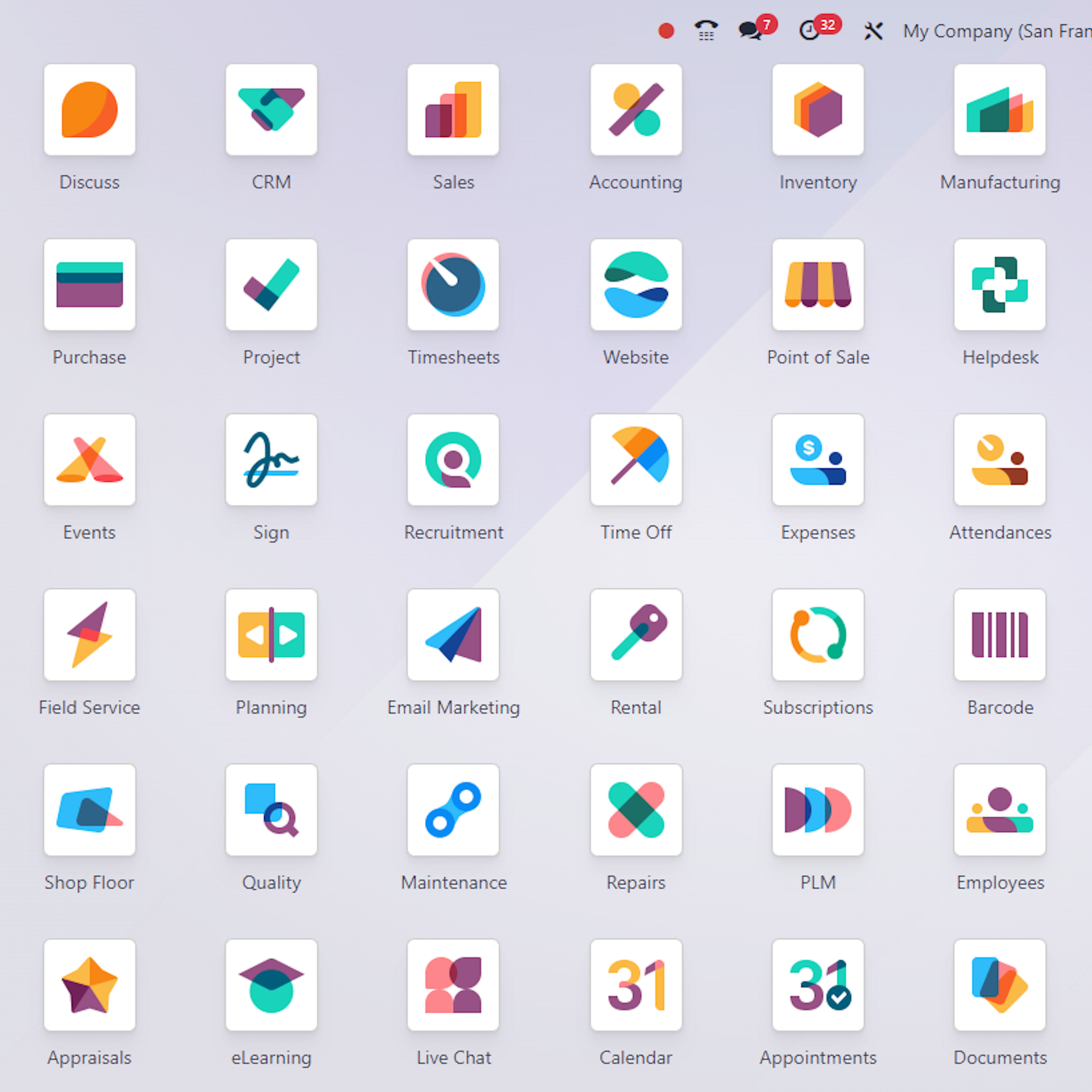
Odoo works through apps that you activate as you go. In practice, four groups cover most of the projects we run. The real question isn’t whether Odoo covers a given area, but in what order to switch it on. Turning everything on day one is the surest way to make a project fail.
The sales cycle.
CRM, quotations, sales orders, invoicing, subscriptions, point of sale, and online store. It’s the most common entry point, because that’s where double data entry costs the most.
The supply chain and manufacturing.
Purchasing, receiving, multi-warehouse inventory, lot and serial number traceability, bills of materials, manufacturing orders, quality, and maintenance.
Finance.
General and analytical accounting, bank reconciliation, expenses, fixed assets, and the e-invoicing covered further down.
Teams and projects.
Project management, timesheets, time off, recruitment, appraisals, and field service.
€€€
How much Odoo costs in France.
An Odoo budget is made up of three distinct lines, which need to be costed separately: the license paid to the publisher, the implementation paid to the partner, and the annual running cost. Most companies budget only for the first, which is the smallest of the three.
The Odoo license.
Odoo Community is free. Odoo Enterprise starts at €24.90 excl. VAT per user per month. One thing the comparisons overlook: an Enterprise license gives access to every app, with no tiers and no modules to buy on top. It’s the clearest difference from the Sage or Cegid models.
Implementation.
For a minimal scope at a small business, sales and invoicing, budget €5,000 excl. VAT. For a standard SME scope, with purchasing, inventory, and accounting, €15,000 to €25,000 excl. VAT. For a multi-module project with data migration and manufacturing or e-commerce, €15,000 to €20,000 excl. VAT. Beyond that, multi-company setups with interfaces and custom development, costing the rollout calls for a deeper analysis.
What drives this figure up is almost never the number of users, contrary to what people assume. It’s three things: the volume of data to migrate, the number of interfaces with your existing tools, and the share of custom development.
The annual running cost.
This is the line nobody documents, and the one that comes back every year: hosting (around €900/year), support and maintenance (€2,000 to €3,000 for a first year of use), and training for new joiners (€1,000). A version upgrade is needed every 2 to 3 years; for a fully standard project, the cost is a few hundred euros.
The cost of a version upgrade is directly proportional to the volume of custom code. That’s why we make the case for the standard: over five years, an Odoo kept close to standard costs significantly less than a heavily customized one.
Odoo Enterprise or Odoo Community ?
Community is free, but it stops where most companies’ needs begin: full accounting, document management, electronic signature, mobile apps, updates, and publisher support. It also assumes that someone on your side knows how to maintain a Python and PostgreSQL instance.
Our position is straightforward: beyond 5 employees, or whenever there’s no in-house developer, Enterprise is the default choice. Community makes sense for an organization that has the technical skills and is willing to handle its own updates.
On top of that, some apps, such as accounting, e-invoicing, and subscription management, are only available in Odoo Enterprise.
Compare the editions

See what Odoo could look like for your business.
A first meeting to see whether we’re a good fit, along with a demo tailored to your processes.
Hosting
Where to host Odoo.
Four options.
The deciding factor here isn’t price but the ability to host custom code, and where the data sits. At Dynapps, we recommend the Odoo.sh platform by default for all projects, for top-quality hosting in Europe. For more specific needs, Dynapps also offers managed hosting through its DynCloud technology.
↗ Lire plus
Odoo Online
The simplest option: the publisher manages everything, but custom code isn’t possible.
Odoo.sh
A managed cloud that supports custom development, with test environments and a deployment history.
DynCloud
A cloud service built and monitored by Dynapps, tailored specifically to precise Odoo needs.
Your infrastructure
Still relevant when regulatory or integration constraints require it.
Odoo and e-invoicing.
The reform is now in force. Since 1 September 2026, all VAT-registered businesses must be able to receive electronic invoices through an approved platform; large companies and mid-market firms must also issue them from that date. SMEs, small businesses, micro-businesses, and the self-employed have until 1 September 2027 to start issuing them.
Enable invoicing in Odoo
Our demo with William, enabling e-invoicing screen by screen.
The Odoo procedure in France
Odoo’s full procedure in pictures, to follow alongside the guide.
Everything about invoicing with Dynapps
The cost of non-compliance.
When Odoo isn’t the right choice.
We’d rather say it at the first meeting than at the third steering committee. Four situations where we advise against Odoo.
A small team with simple processes.
Below 3 users and with no inventory or manufacturing complexity, an invoicing tool and a spreadsheet can be enough. The implementation cost won’t pay off.
A highly specialized business with a mature vertical software.
Rebuilding in Odoo what an industry-specific publisher has refined over twenty years costs more and covers less (Agicap for cash-flow management, for example).
An organization that wants to replicate everything exactly as it is.
If every departure from the standard becomes a development, you’ll end up with an ERP that’s expensive to maintain and painful to evolve. Without a willingness to rethink processes, the project will fail whatever solution you pick.
A company with no in-house point person available.
Without a sponsor and business point people who can be freed up for the workshops, the rollout grinds to a halt. It’s the number-one cause of failure we see.
Training
Funding Odoo training and the project.
Two levers exist, and they don’t kick in at the same point.
Training your teams.
Our Odoo training is delivered by Practical Training, a Qualiopi-certified provider, which makes it eligible for funding from your OPCO [industry training fund]. Eight tracks, from getting started to the individual modules, in 3.5-hour or 7-hour sessions, five participants maximum, on site or remote. Two conditions for the application to go through: the training must be invoiced separately from the implementation, and the request filed before the session starts. The one-month gap between signing and the first day is enough to put it together. Qualiopi makes funding possible, with each OPCO then setting its own criteria and ceilings.
The software and implementation.
Direct digitalization grants fall under the Regions, with France Num mainly serving for assessment and guidance. Amounts and conditions vary widely from one area to the next, and some Regions require an approved provider. We operate in Occitanie, Nouvelle-Aquitaine, Grand Est, and Pays de la Loire: tell us where you’re based and we’ll look at what’s available before costing the project. Two habits worth keeping: check eligibility before you sign, since most schemes reject expenses already committed, and never submit the same expense to two funders.
Our clients success stories
What we’ve already done.
- Food & beverage

Food & beverage
Cazes: Odoo at the counter, SAP for the group books
Cazes moved its boutique and wine-fair sales onto Odoo Point of Sale, retired a clumsy SAP Fiori till, and left accounting, invoicing and alcohol duties on the Advini group's SAP S/4.
- Professional services

Professional services
One Odoo across three Obiz Group entities
A listed French loyalty group put three entities on one Odoo within a year of an acquisition. The acquirer extended the platform its target had already chosen, covering accounting, purchasing and sales.
Who is Dynapps?
Dynapps digitalizes businesses in Odoo. As the #1 partner in France and Europe and an Odoo Gold Partner, we help our clients streamline their processes, reduce their operating costs, and accelerate their growth through an integrated ERP platform. With 280+ experts across 5 countries and 4 offices in France (Toulouse, Bayonne, Nantes, Strasbourg), our teams master the specific challenges of SMEs and mid-market companies going through digital transformation, with dedicated vertical expertise for each sector.
Read more

Les fondamentales Odoo : qui, quoi, où, quand, comment, combien.
Odoo is an integrated business management software suite developed by the Belgian company Odoo SA. It is based on a modular architecture: more than 50 applications share a single database, which can be activated as needed. It is accessed via a web browser and is available in a Community edition—which is free and open source—or an Enterprise edition, which is paid per user.
Odoo SA is a Belgian company. France is its second-largest market worldwide after the United States, and the company opened a Lyon-based office there in 2026. For French customers, this means having a local point of contact at the company in addition to the network of integration partners.
Primarily for companies with 10 to 1000 employees, across all sectors: manufacturing, wholesale, retail, services, e-commerce, and construction. Larger organizations also use it. For organizations with fewer than 3 users and simple processes, we generally do not recommend making the switch.
The Community Edition is free and open source. The Enterprise Edition is a paid service, starting at €24.90 (excluding tax) per user per month. Be careful not to jump to conclusions: free does not mean at no cost. With the Community Edition, you are fully responsible for hosting, maintenance, and version upgrades.
Three line items, to be priced separately: the license, implementation (starting at €10,000-15,000, depending on the scope), and annual operating costs, which include hosting, support, and version upgrades. The license is the most visible of the three and almost always the smallest.
Depending on the option you choose: Odoo Online, Odoo.sh, DynCloud, or your own infrastructure. For hosting provided by Odoo (Online/Odoo.sh) and DynCloud, the hosting is located in Europe. This is a critical consideration in public procurement and regulated sectors.
Within a limited and well-defined scope, the first batch goes into production in 10 to 14 weeks. A full deployment—including multiple modules, data migration, and change management support—takes 2 to 5 months.
The factors that cause a project to run over schedule are almost never technical: they include the quality of existing data, the availability of subject-matter experts, and the number of internal approvals. The limiting factor almost always lies with the client, and it’s best to know this before signing off on a schedule.
In five phases, with a deliverable at each stage: the scoping phase defines the scope and budget; the design phase produces a configured prototype approved by your key contacts; deployment delivers the complete configuration of the Odoo database, along with any necessary custom developments and interfaces; go-live finalises data migration, training, and the go-live report; operations provide support, enhancements, and the release roadmap.
Yes, provided it is configured correctly: full French accounting, accounting entries file (FEC), archiving, and electronic invoicing, since Odoo is certified as an Approved Platform.
Yes, provided that you use a structured format (Factur-X, UBL, or CII) and go through an approved platform. Reminder of the timeline: mandatory receipt for all businesses as of 1 September 2026; mandatory issuance for small and micro-enterprises as of 1 September 2027.
The price does not depend on the number of users but on the amount of custom development that needs to be maintained. A standard Odoo installation is easier to update; a heavily customized Odoo installation can cost several times that amount each year. This is the main argument in favour of the standard version.
Yes, and it happens more often than people realize. We start with a takeover audit: assessing the instance’s functional and technical status, taking inventory of the specific code, identifying accumulated technical debt, and outlining short-term tasks. The takeover estimate follows, based on this audit. Read more on : Recover your Odoo.
We regularly take on poorly configured or abandoned systems. The process is always the same: we conduct an audit before making recommendations. In most cases, the database can be recovered, and the problem stems from the initial scope or excessive specificity—not from the tool itself.
As little as possible. Every development effort is paid for twice: once when it’s created, and then again with every version update. Our rule is to meet standard requirements wherever possible and to reserve custom features for what constitutes a real competitive advantage.
Yes, via API or connector. The most common use cases involve payroll, banking, e-commerce, EDI, and line-of-business software. Here are a few examples of integrations supported by Odoo and Dynapps:
Banks: Odoo supports thousands of banks in Europe, including all the major French banking groups.
Payroll: Silae
Cash management: Agicap
E-commerce: PrestaShop, Magento, WooCommerce, Sylius
Carriers (DHL/UPS/FedEx-style parcel services or traditional carriers)
EDI
CRM: HubSpot
Yes, through your OPCO, provided two conditions are met: the training must be provided by a Qualiopi-certified organization, which is the case for Practical Training, with whom we work, and it must be billed separately from the implementation. The request must be submitted before the session begins. Our sessions last 3.5 hours or 7 hours, accommodate a maximum of five participants, and start at €700 (excluding tax). The actual coverage and its maximum limit depend on your OPCO. Allow 1 to 2 days per user profile and 5 to 10 days for administrators.
Sometimes. If there are three or more users, or if there’s inventory, production, or multiple unconnected tools involved, then yes. For smaller setups with simple processes, the cost of integration isn’t justified, and we’ll tell you so.
Three, which we’ll go ahead and mention. The pace of one major release per year requires a disciplined approach to updates. The depth of functionality remains inferior to that of vendors specialising in certain highly vertical industries. And the ease of customisation is a trap: it encourages development where a process should have been reworked instead. Projects that go off the rails almost always do so because of this.
See what Odoo could look like for your business.
A first meeting to see whether we’re a good fit, along with a demo tailored to your processes.