
One Odoo platform across three webshops and fourteen European markets.
Three companies, three ERPs, three webshops, three middleware components. When the manufacturer of the central system pulled the plug, Orion brought it all onto one Odoo platform: one central database, intercompany flows between the entities, and the three storefronts integrated end to end.

Sector
Retail & wholesale.
Footprint
One warehouse in Veghel, NL, serving 14 European countries through three companies.
Scale
Three companies, three webshops, one Odoo platform with intercompany flows.
Dynapps partner
Since 2022.
Backing
Atraxion (parent / investor, also a Dynapps customer).
Before Dynapps stepped in.
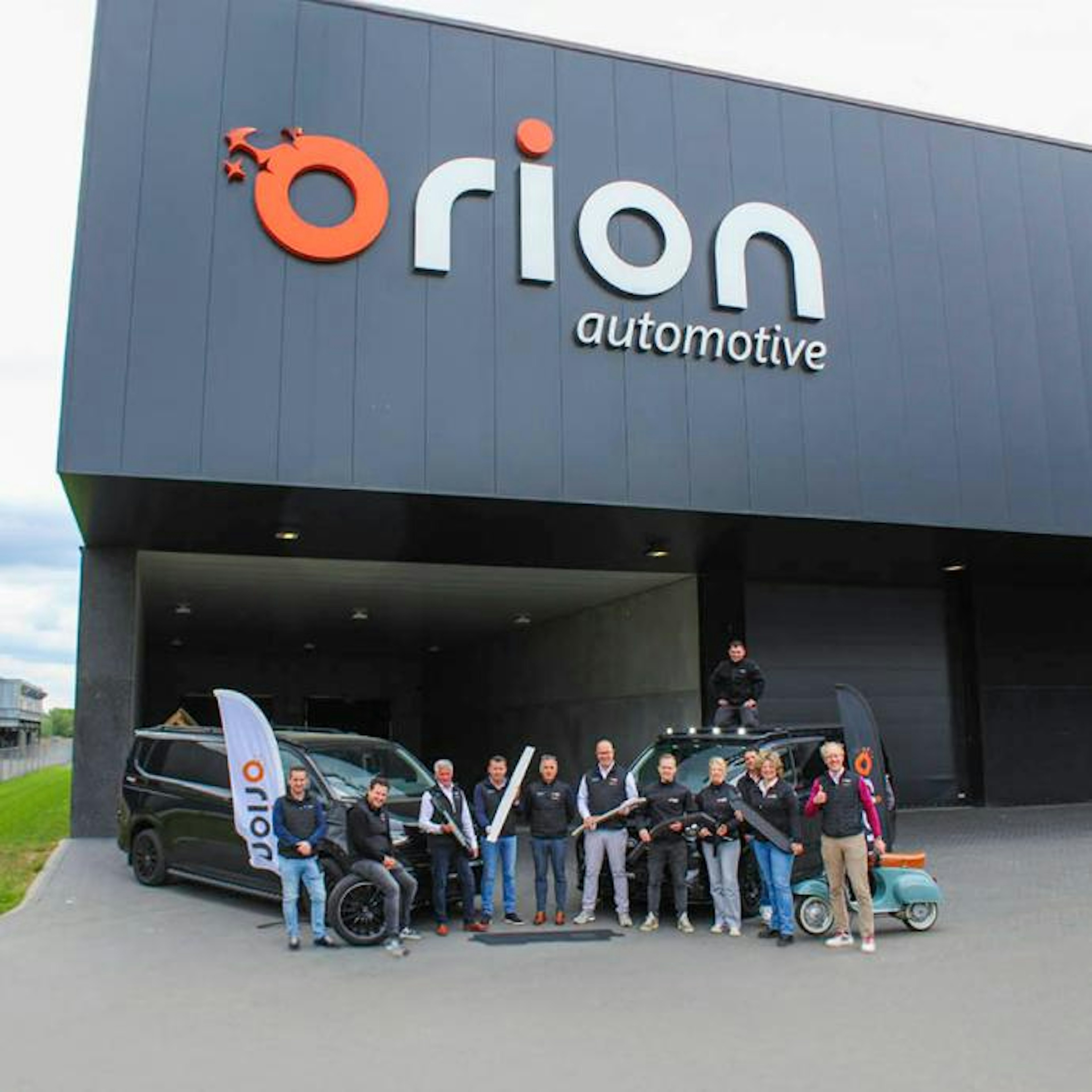
Orion Automotive is a Dutch van-accessories specialist founded in 1999. By 2020 the company sat under a parent (Atraxion) and ran as three legal entities: Orion itself (NL, the central operation), a Dutch B2C webshop business, and a German B2C webshop business with its own VAT regime. Each entity ran its own ERP, its own website, its own middleware. Everything Orion did, it did three times.
In August 2020, Gerry Goormans took over as General Manager. He arrived with a six-year transformation programme called Project 2025: doubling turnover in five years while holding margin, professionalising the operation, expanding across Europe. The ERP replacement was scheduled for phase five (2025). Then in 2022 the manufacturer of the central ERP announced it would pull the plug, and phase five had to happen now.
The challenge
Where the cracks showed.
Three of everything
Three companies meant three ERP packages, three websites, three middleware components. A product update required logging into three back offices and making the same change three times. A customer existed three times; stock was reconciled across three systems. Gerry: "Everything we did we had to do three times."
The central ERP exists
In 2022 the manufacturer of the central ERP (Mamut Business Software) announced its end of life. The system that handled sales, purchasing, inventory and accounting was about to be unsupported, with no fallback queued. The ERP project, scheduled for 2025, had to start now.
Carriers and checkouts, three setups
In 2022 the manufacturer of the central ERP (Mamut Business Software) announced its end of life. The system that handled sales, purchasing, inventory and accounting was about to be unsupported, with no fallback queued. The ERP project, scheduled for 2025, had to start now.
Why Orion chose Odoo and a partner that would say no.
Project 2025 had placed the ERP replacement in phase five (2025). The end-of-life announcement collapsed that runway to nothing. Orion negotiated extended support for a defined window with the outgoing vendor, and used that window to run a market analysis.
Three paths on the table:
Patch the middleware and replace each entity's ERP separately
It would have rebuilt the same three-systems fragmentation on a newer stack, with the same product-in-four-places problem underneath.
A tier-one mid-market ERP for all three entities
Stayed in the running through the market analysis. Lost on the two anchor requirements: multi-entity intercompany flows in one central system, and webshop integration native to the ERP rather than held together with external middleware. As Gerry put it, "there were few packages that could offer us what we needed."
Odoo, with Dynapps holding the line
The sister company was already running Odoo, with results Gerry could see directly. Native multi-entity, native webshop integration. Dynapps brought the discipline to hold the line on scope, willing to say "yes, that is possible, but that is not the case now" rather than reach for the Taj Mahal when a simple home would do.
How the rollout really happened
How Orion went live on Odoo in nine months.
Early 2022
Central ERP (Mamut) end-of-life announced. Extended support negotiated. Platform decision taken in favour of Odoo.
End 2022
Dynapps engagement kicks off; ERP and three webshops as one programme.
2023
Go-live on Odoo v16: back office and three webshops, with DeliveryMatch and Multisafepay integrated.
2024
Continued evolution, with later changes carried by a second Dynapps team and the service team.
What Orion built on Odoo: one database, three storefronts, intercompany flows.
One central database at Orion now holds the three companies. When a B2C sale lands on the NL or DE webshop, a purchase is generated from Orion automatically, central stock is shared, and the full logistics chain (delivery, invoicing, carrier choice, track-and-trace) runs end to end inside one package. One Dynapps team carried the programme, a project manager, three business consultants (logistics, finance, web) and three developers, with Bob Verdonck on logistics. On Orion's side, five key users on the backend plus two on the webshop, supported by third-party application partners.
Modules: sales, purchase, inventory, accounting, website & eCommerce, product-configuration modules, DeliveryMatch (multi-carrier), multisafepay (payments).
The discipline throughout.
Foundation first, nice-to-have later. When opening Odoo, the temptation is to build the Taj Mahal. Orion and Dynapps deliberately did the opposite: the foundation had to be standing and yield a full return on day-to-day operations before the ‘nice to have’ layer. Gerry: “We looked at how we could do the things we do have better and more efficiently.” Dynapps held the line by being willing to say “yes, that is possible, but that is not the case now.”

Why master data and product variants were the hard part.
Three ERPs, three webshops, three middleware components: products lived six times, customers three, stock three. Gerry: "Your master data is the foundation of everything. If that is OK, you can continue building." At go-live, which version was correct became a daily call, and "regularly clean up master data" landed as the headline lesson. Edge cases not in test data arrived in the live queue; the fix was organisational, someone watching exceptions on day one rather than taking a victory lap.
The hardest piece sat under the product catalogue. Odoo's product-variant configuration was not a data exercise, it was a complete change in how Orion thought about its products. The lesson: invest in the new product model from day one, not at the back of the project under the name data migration.
Not in a quiet room either. Mid-project, Orion moved two industrial halls in two weeks into a new European headquarters not yet finished, delayed by COVID and then by the war. Gerry: "The migration to Odoo was much more drastic than the physical move of those companies."

The migration to Odoo was far more impactful than our physical move of two companies. That’s when you need a partner who works in a structured and planned manner.
Gerry Goormans
General Manager at Orion AutomotiveWhat Orion taught Dynapps about multi-webshop integrations.
The Orion engagement shaped how Dynapps approaches multi-webshop integrations on a shared backbone. Three lessons have informed the standard approach since: regularly clean master data (a recurring hygiene cycle, not a one-off pre-migration sweep, so reporting and decisions can be trusted); test integration scenarios thoroughly but plan for unforeseen issues at cut-over (continuous monitoring on day one rather than a victory lap, with proactive triage for the exceptions that surface); and phase the rollout by process (automate one workflow at a time and let people adapt, rather than swinging the full stack in a single weekend).
Two concrete carry-overs anchor the lessons in current practice. The Dynapps product import tool is a direct consequence of the Orion product-variant work, built so the next customer does not have to learn the same way Orion did. And test scenarios now sit inside Functional Unit Designs by default, making the second lesson a process commitment rather than a personal habit.
The numbers
By mid-2023, three companies ran on one Odoo platform with intercompany flows.
What used to be done three times now happens once. One central Odoo database holds the three companies, with intercompany flows turning a B2C webshop sale into an automatic purchase from Orion against shared central stock. All three storefronts run on the same platform, with DeliveryMatch for carriers and Multisafepay for checkout, so back office and webshops read from one source.
3 → 1
companies, ERPs and webshops consolidated onto one Odoo platform with intercompany flows.
14
European countries served from one warehouse in Veghel, NL.
9
months from October 2022 kickoff to 17 July 2023 go-live.
80-120
orders per day now processed through scanning and inventory-location management.
From ‘keep three systems talking’ to ‘what do we build next?’.
The default question shifted from “how do we keep three companies, three ERPs and three webshops talking to each other” to “what is the next thing we want to build.” With one Odoo platform underneath, Project 2025’s remaining ambitions stopped being held back by the systems. Gerry: “We want to become the best in van accessories in Europe. We are already working on virtual reality for product development, where we can use 3D data to simulate a product on a car that is yet to come. These are challenges for which we have laid the foundations with Dynapps and Odoo.” The platform is no longer the project; it is the floor the next project stands on.
If this sounds familiar, let’s talk.
Wherever your business is heading and wherever it's getting stuck, an expert who has run this kind of work is the right person to start with, before you commit to a direction or a platform.
Go deeper
Read further.
Implement Odoo
From blueprint to go-live, built around how your industry actually operates.
Replacing a legacy ERP
The ERP that built the business now holds it back. Ten or twenty years of SAP Business One, Exact, Navision, Sage, or a custom build sits at the centre of operations, wrapped in integrations and spreadsheets only a few people understand.
Retail & wholesale
Brick, click, and warehouse. One stock. One view.
More stories like this
- Food & beverage
Food & beverage
Cazes: Odoo at the counter, SAP for the group books
Cazes moved its boutique and wine-fair sales onto Odoo Point of Sale, retired a clumsy SAP Fiori till, and left accounting, invoicing and alcohol duties on the Advini group's SAP S/4.
- Manufacturing
Manufacturing
How Nobi tracks every smart lamp from the Belgian assembly line to the care room.
A fast-growing health-tech manufacturer tried to stand up Odoo itself, hit a wall on serial-number traceability, and turned to Dynapps to clean up the setup and rebuild the flow, from component picking to a fully documented, serial-tracked finished product.
- Retail & wholesale
Retail & wholesale
Ergonomio replaced a twenty-year custom FileMaker webshop with one Odoo platform.
Moving from a bespoke FileMaker system to standard Odoo meant rebuilding every product record and letting go of a two-decade-old way of working.
- Energy & utilities

Energy & utilities
One Odoo platform for a multi-company energy consultancy: Tunérgia replaces Telegram, Excel and scattered tools
After sixteen years on paper, Excel and Telegram, Tunérgia put its multi-company energy consultancy onto one Odoo platform with Dynapps: leads, projects, signatures and surveys in one traceable place.
- Food & beverage
Food & beverage
One Odoo template across 14 Puratos production sites in four continents
Belgian family-owned ingredients manufacturer, 75 production units across 55 countries. Kept SAP at the largest sites; built one Odoo template for the smaller acquisitions.
- Financial services

Financial services
One Odoo backbone, from 100 to 36,000 leased bikes
Cyclis Bike Lease grew from a four-founder startup in Hasselt to 36,000+ leased bikes. Dynapps replaced the founders’ DIY setup with a single Odoo platform that scales with the business.
- Laboratories
Laboratories
Seven specialised labs on one integrated Odoo and LIMS platform
Seven specialised lab departments across Oman, 65,000 samples a year. The group replaced a legacy LIMS and added an ERP on one integrated Odoo and LIMS platform in four months.
- Energy & utilities
Energie en nutsbedrijven
Sensorfact heeft het inkopen op basis van intuïtie vervangen door Odoo
Nederlandse klimaattechnologie-startup, met meer dan 200 medewerkers die 1.600 industriële klanten in 40 landen bedienen. Odoo heeft binnen vijf maanden het op gevoel inkopen vervangen door één systeem voor inkoop, voorraadbeheer, boekhouding en verkoop.
- Retail & wholesale

Retail & wholesale
One Odoo across sales, purchasing, accounting: four-month cutover
Swiss distributor of corporate clothing and promotional products, with 13 users on Odoo. One platform now covers sales, purchasing and accounting, ending a multi-year search.
- Retail & wholesale
Retail & wholesale
One Odoo backbone for a B2B safety distributor, with 95% of orders flowing through the web shop
A Spanish B2B distributor of high-visibility safety gear moved off a custom legacy system onto Odoo. A bulk-order grid on standard e-commerce now carries 95% of its orders.